Waqf Board Chairman Urges CM to Abolish Chhattisgarh Madrasa Board, Set Up Minority Education Authority

Raipur
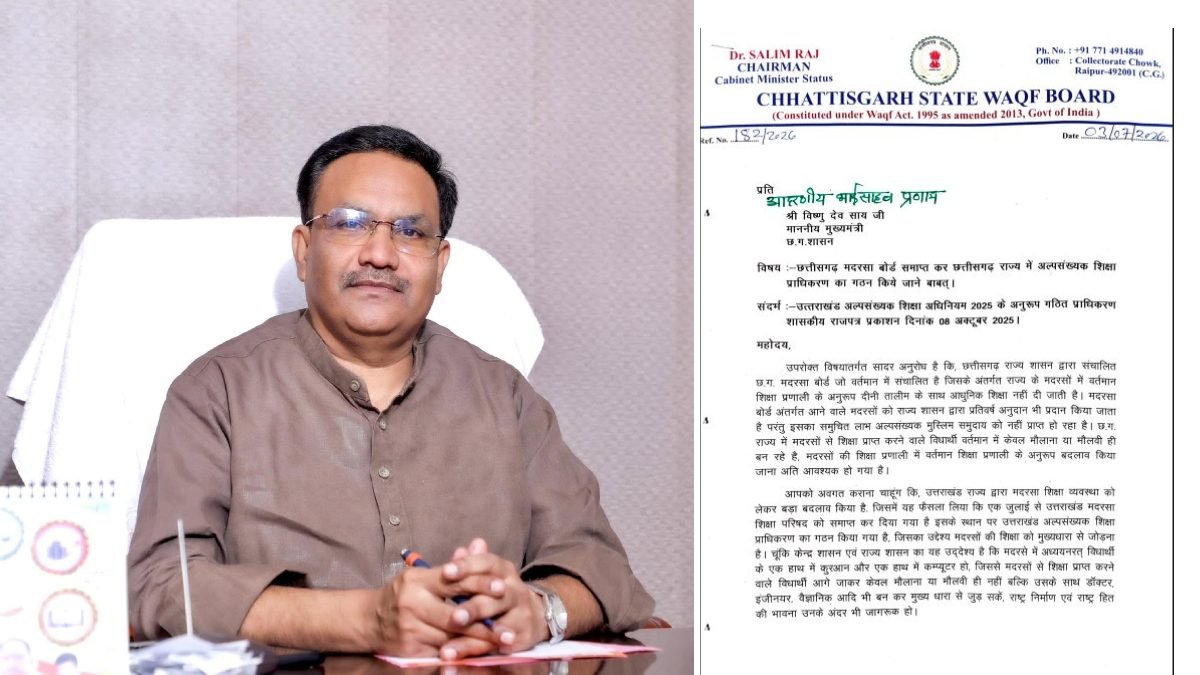
Chhattisgarh State Waqf Board Chairman Dr. Salim Raj has written to Chief Minister Vishnu Deo Sai, urging the state government to dissolve the Chhattisgarh Madrasa Board and establish a Chhattisgarh Minority Education Authority on the lines of Uttarakhand, with the aim of integrating madrasa education into the mainstream education system.
In a letter dated July 3, 2026, Dr. Raj argued that the existing madrasa education system in the state does not adequately provide modern education alongside religious instruction, limiting educational and career opportunities for students studying in madrasas. He said that while the state government provides annual grants to madrasas, the intended benefits are not fully reaching students from the minority Muslim community.
Referring to reforms undertaken by the Uttarakhand government, Dr. Raj noted that the neighbouring state had abolished its Madrasa Education Council and constituted a Minority Education Authority under the Uttarakhand Minority Education Act, 2025. He said the objective was to connect madrasa education with the mainstream by combining religious studies with modern subjects, enabling students to pursue careers as doctors, engineers, scientists and other professionals while remaining rooted in their religious education.
The Waqf Board Chairman stated that Chhattisgarh has around 418 madrasas, of which some are fully grant-in-aid institutions, while others are recognised up to the primary, secondary and higher secondary levels. He claimed that many institutions continue to focus primarily on religious education and lack curricula aligned with the contemporary education system, raising concerns about students’ future prospects.
Dr. Raj proposed that all madrasas in the state be brought under the School Education Department or the School Education Council. He also recommended constituting an expert committee to determine the extent to which modern subjects should be incorporated alongside religious education. According to him, such reforms would help madrasa students compete with their peers from other schools, improve their employability, and facilitate skill development.
In his concluding appeal, Dr. Raj requested the Chief Minister to abolish the existing Madrasa Board and replace it with the proposed Minority Education Authority so that students enrolled in madrasas receive modern education and become part of the educational mainstream. The letter enclosed a copy of the Uttarakhand government gazette relating to the formation of the Minority Education Authority as a reference for the proposed reforms.