Amit Shah Inaugurates NCB Regional Office in Raipur, Emphasizes Zero-Tolerance Against Drug Trade


Raipur
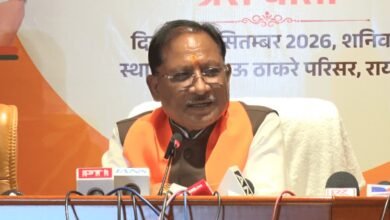
Union Home and Cooperation Minister Amit Shah on Sunday virtually inaugurated the regional office of the Narcotics Control Bureau (NCB) in Nava Raipur, Chhattisgarh. Shah also presided over a review meeting on the drug scenario in Chhattisgarh. The event was attended by Chhattisgarh Chief Minister Vishnudeo Sai, Union Minister of State for Home Affairs Nityanand Rai, Chhattisgarh Deputy Chief Minister Vijay Sharma, Union Home Secretary, Director of the Intelligence Bureau, NCB Director-General, Chhattisgarh Chief Secretary, Director-General of Police, and several other dignitaries.

The Union Home Minister stated that Prime Minister Narendra Modi’s vision of a drug-free India by the centenary year of the country’s independence in 2047 is becoming a collective resolve for every citizen. He emphasized that the commitment to a drug-free India is crucial for building a prosperous, secure, and glorious nation. Shah pointed out that drugs are not just an issue for India but a global problem.
The Union Home Minister asserted that the fight against drugs in India can be won with determination, seriousness, and a comprehensive strategy. He highlighted that the illicit narcotics trade in India is linked to national security, as the money generated from drug trafficking fuels terrorism, left-wing extremism, and weakens the country’s economy. He added that drugs not only destroy the youth of the nation but also undermine its security.
Shah urged everyone to adopt a zero-tolerance policy towards narcotics and fulfill Prime Minister Modi’s vision of a drug-free India. He mentioned that the NCB’s Raipur Zonal Office was inaugurated today and will play a significant role in controlling narcotics not only in the state but throughout the region. He stated that the goal is to have an NCB presence in every state across the country. The Modi government will establish NCB offices in every state to collaborate with state governments in eradicating the drug trade.
He also noted that the trend in drug trafficking is shifting from natural to synthetic drugs. He pointed out that the percentage of sedative use in Chhattisgarh is 1.45%, which is higher than the national average, and cannabis use is 4.98%, also above the national average. Amit Shah stressed the importance of using scientific methods in the investigation of drug trafficking cases. He emphasized the need to work with a top-to-bottom and bottom-to-top approach to ruthlessly dismantle the entire network. He added that until the entire network is targeted, the goal of a drug-free India cannot be achieved.

Shah remarked that while drug users are victims, those involved in the drug trade are criminals. He outlined a four-point strategy for success in the fight against drugs: detection of drugs, destruction of networks, detention of culprits, and rehabilitation of addicts. He said that the “Whole of Government” approach is necessary to achieve complete success in the fight against drugs.
He highlighted the significant achievements of the NCB under Prime Minister Modi’s leadership over the past 10 years. He reported that from 2004 to 2014, a total of 1,250 cases were registered, while from 2014 to 2024, there was a 230% increase, with 4,150 cases registered. Arrests increased from 1,360 between 2004 and 2014 to 6,300 now. Similarly, the quantity of drugs seized rose from 152,000 kilograms between 2004 and 2014 to 543,000 kilograms between 2014 and 2024, a 257% increase. The value of drugs seized went from Rs 5,900 crores between 2004 and 2014 to Rs 22,000 crores between 2014 and 2024. Shah said that under Prime Minister Modi’s leadership, a coordinated approach has enabled significant progress in the fight against drugs over the past decade. He emphasized the need to turn the fight against narcotics into a mass movement by raising awareness among the youth and the general public about the dangers of drugs.
He stressed the importance of holding regular meetings at all four levels under the Narco Coordination Mechanism. He urged the use of the recently launched ‘MANS’ portal by all stakeholders. Shah encouraged states to seek assistance from central government agencies for financial investigations in drug-related cases. He also emphasized the need for the regular use of the Joint Coordination Committee and suggested that inter-state drug cases should be handed over to the NCB to dismantle the entire network.