Electricity tariff increased in Chhattisgarh: Domestic consumers to face 30–50 paise per unit hike

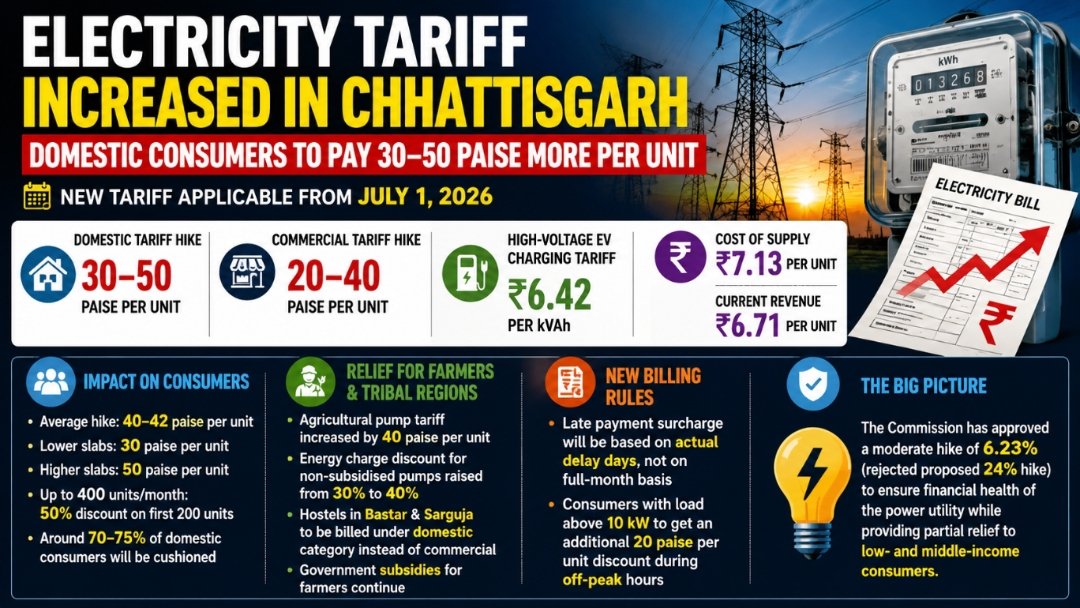
RAIPUR — The Chhattisgarh State Electricity Regulatory Commission (CSERC) has announced revised power tariffs for the financial year 2026–27, making electricity costlier across the state. The new rates will be effective from July 1, 2026.
Domestic consumers will see an increase of 30 to 50 paise per unit, while commercial tariffs will rise by 20 to 40 paise per unit. The Commission rejected the distribution company’s proposed 24% hike and approved an average increase of 6.23%.
⚡ EV and supply cost details
- High-voltage EV charging stations tariff fixed at ₹6.42 per kVAh
- Average cost of electricity supply: ₹7.13 per unit
- Current revenue: ₹6.71 per unit
👨👩👧 Impact on consumers
According to CSERC, the average increase is around 40–42 paise per unit, but it is not uniform across categories.
- Lower consumption slabs: 30 paise per unit increase
- Higher consumption slabs: 50 paise per unit increase
The state’s electricity bill waiver scheme will continue. Domestic consumers using up to 400 units per month will still receive a 50% discount on the first 200 units. Around 70–75% of domestic consumers fall under this category, limiting the effective burden to about 15–20 paise per unit for low- and middle-income households.
🌾 Relief for farmers and tribal regions
- Agricultural pump tariff increased by 40 paise per unit
- Energy charge discount for non-subsidised agricultural pumps raised from 30% to 40%
- Hostels in Bastar and Sarguja tribal development regions will now be billed under the domestic category instead of commercial, reducing costs significantly
- Government subsidies for farmers will continue to provide major relief
🧾 New billing rules
- Late payment surcharge will now be calculated based on actual delay days instead of full-month billing
- Consumers with load above 10 kW will get an additional 20 paise per unit discount for using electricity during off-peak hours
Overall, the Commission has approved a moderate tariff hike, aiming to balance financial viability of the power utility while limiting the burden on low- and middle-income consumers.