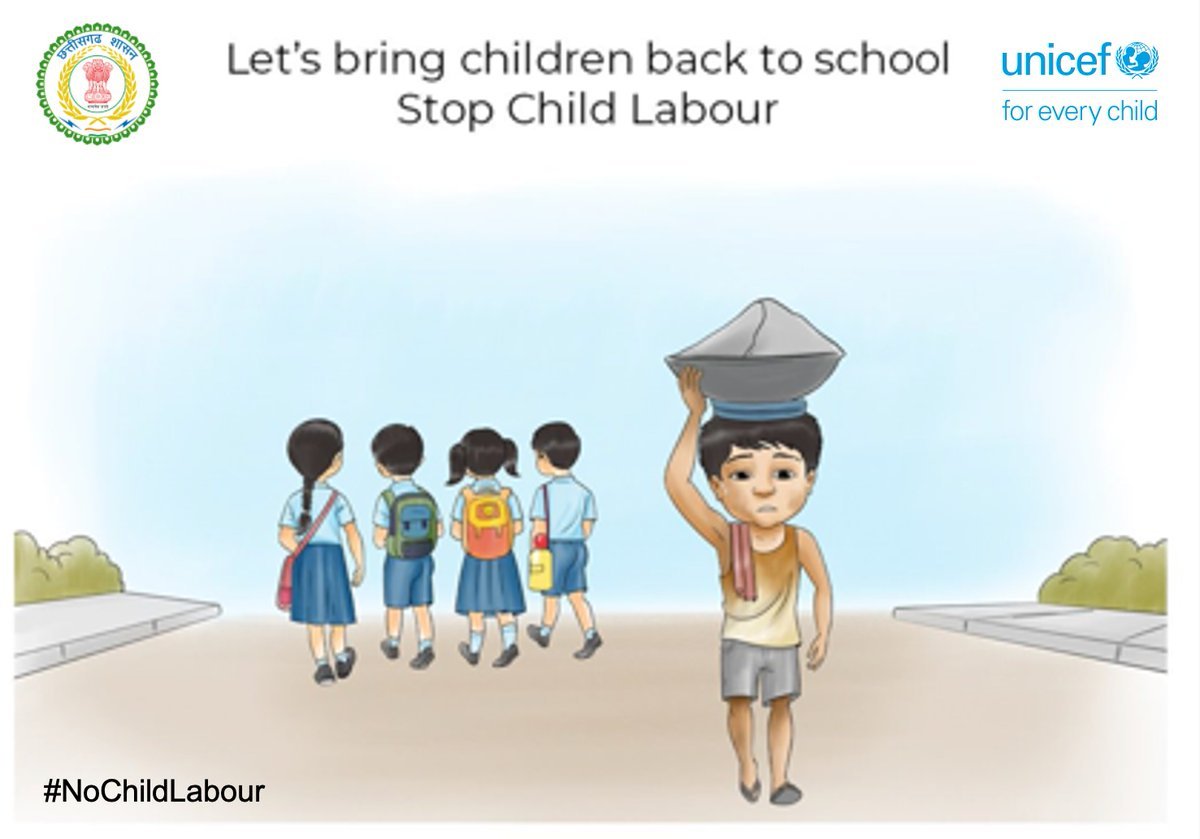
We spoke to Mr. Job Zachariah, Chief of UNICEF Chhattisgarh on child labour as the World Day against child labour is observed on 12 June. UNICEF and the Labour Department of the Chhattisgarh Government has initiated a state-wide campaign from 30 April (the National anti-child labour day) to 12 June. Stating that child labour is a violation of child rights, Mr Zachariah says that it is also a crime against humanity.
What is child labour?
Any work that deprives children of their education and childhood and which is harmful to their physical and mental development, is considered as child labour. For example, if a child is engaged for long hours after the school time, and if the child is deprived of play and leisure, then it is child labour.
Do household chores like cleaning rooms or washing plates come under child labour?
Helping parents at home in household chores, learning traditional skills and assisting in non-hazardous family business, without affecting the education and play of children, is not child labour.
What are the consequences of child labour?
Child labour deprives children of their fundamental right to education and physical, emotional, and mental development. It also deprives of joyful childhood, play and leisure. Besides, child labour keeps away children from their families, denying their love and affection.
Contrary, to the general impression, child labour causes and perpetuates poverty and illiteracy. Child labour leads to low productivity, unemployment of adults and loss in gross domestic product (GDP) of the country. According to an ILO study, one dollar invested in eradication of child labour will give return of seven dollars in 20 years
Do you think child labour has declined in India? What is the current situation?
In 2011, about one crore (10 million) children of 5-14 years were engaged in work in India, as per 2011 Census. We do not have reliable data on the current situation on child labour, as the Census has not been conducted since 2011.
A proxy indicator for child labour is the number of out-of-school children. According to the latest assessment of the Government of India, the number of such children has drastically reduced in the last 10-12 years. As per official records, there are only 9.3 lakh children who do not attend elementary school in classes 1 to 8 and the gross enrolment ratio (GER) at the elementary stage is as high as 100 in India (U-DISE 2021-22).
Is child labour banned in india?
Yes, In India, employment of children below 14 years in any occupation or process is prohibited under the Child and adolescent labour (prohibition and regulation) Act, 1986. The Act also prohibits employment of adolescents of 14 to 18 years in 15 hazardous occupations (such as in circus, dhabas, domestic work, automobile workshops) and 54 processes (such as manufacture of carpets, soaps, cement, pesticides, glass, and paper).
What are the causes of child labour?
Major causes of child labour are illiteracy of parents, poor access to quality education and school drop-out. Another reason is the cost of education. Although education is free, parents have to spend on dress, pen, notebooks, transport of school going children. Some employers prefer child labour because it is cheap labour without any expenditure on insurance, social security, and other benefits.
It is generally believed that poverty is the cause for child labour. Is it true?
Not fully correct. Poor parents often send their children to work to supplement the family income. But, most child labourers get only paltry payment for their work, and it does not address the poverty and vulnerability of the family. When child labourers become adults, they get only low paid jobs because of low levels of education. This leads to vicious cycle of poverty and child labour. Therefore, child labour is the cause as well as the consequence of child labour
How can child labour be prevented?
Education is the best insurance against child labour. If all children attend school up to 18 years regularly, then there would not be any child labour. Often, children are engaged in work when they drop-out from school.
Ensuring social protection benefits to vulnerable and poor families, is critical for eliminating child labour. Other measures to prevent child labour includes enforcement of laws (such as child labour prohibition act); creating social norms in society and family in favour of education and against child labour; and strengthening the child protection structures with robust monitoring and tracking of child labour, school drop-out.
What can general public do for preventing and reporting child labour?
When the general public see a child labour in a dabha, hotel, garage, or any other enterprise, they should not take services from such units. This will be a big disincentive for the people engaging child labour. Similarly, we should boycott all items made by child labour. When we see children engaged in work, we should report it by calling Childline no 1098 or registering