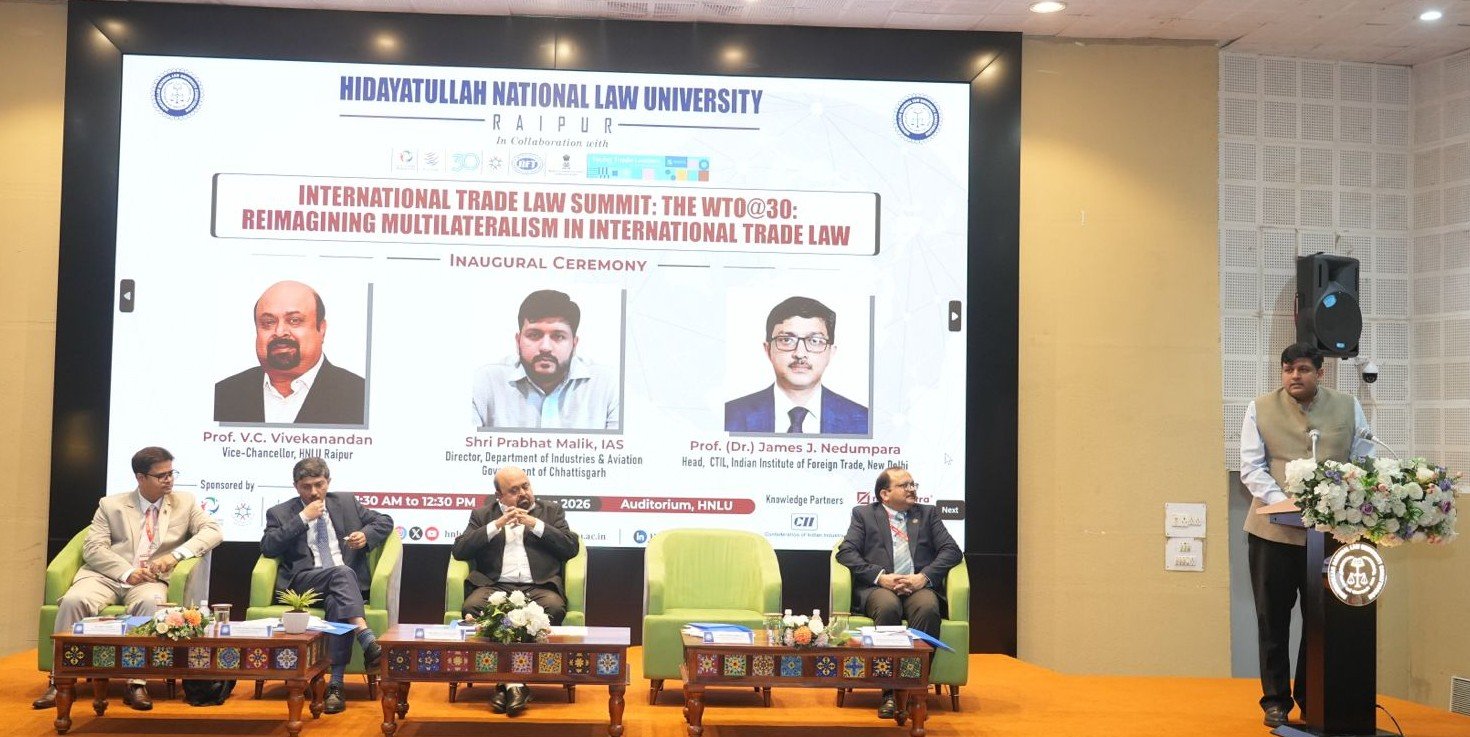
Raipur: Hidayatullah National Law University (HNLU) on Friday inaugurated the three-day International Trade Law Summit (ITLS) 2026, bringing together academics, policymakers, legal practitioners, researchers and students to deliberate on the future of multilateralism in international trade law.
Organised by HNLU’s School for Law & Technology and Centre for WTO & WIPO Studies in collaboration with academic and institutional partners, the summit is centred on the theme “The WTO@30: Reimagining Multilateralism in International Trade Law.”
HNLU Vice-Chancellor Prof V C Vivekanandan, in his inaugural address, said the summit assumes significance against the backdrop of geopolitical rivalry, technological competition, supply-chain concerns and declining institutional trust. He said trade was not merely about the movement of goods and services but could contribute either to managing confrontation or cultivating cooperation.
Reflecting on the World Trade Organisation (WTO) at 30, Vivekanandan said the global economic landscape had changed considerably, with emerging economies gaining greater influence and new challenges emerging from digital trade, artificial intelligence, environmental measures and global value chains.
He identified four key questions for deliberation: how multilateralism could be reimagined without abandoning its foundational legal principles; how development concerns could be accommodated; how national policy space could coexist with global economic interdependence; and how established and emerging powers could work towards a renewed equilibrium.
“I hope this summit will not merely diagnose the fractures in the trading system. I hope it will imagine the architecture of repair,” he said.
Guest of Honour Prof (Dr) James J Nedumpara, Head, Centre for Trade and Investment Law, Indian Institute of Foreign Trade (IIFT), New Delhi, said international trade could not be examined in isolation from wider social and economic concerns, including human rights, environmental protection, sustainability and labour conditions.
“Trade cannot actually work in silos,” Nedumpara said, stressing that WTO agreements extended beyond trade liberalisation alone. He also called for reforms to the WTO rulebook to address emerging challenges while retaining the centrality of the multilateral system and its judicial function.
“Everyone has to behave like a responsible actor,” he said, emphasising that “the judicial function of the WTO has also to be maintained.”
Chief Guest Prabhat Malik, IAS, Director of Industries & Aviation, Government of Chhattisgarh, highlighted the interface between international trade rules and industries, businesses and citizens at the state and regional levels.
Speaking in the context of governance and administrative reforms, Malik said: “Either you improve the rules, either you enforce compliance, or you make the process easy.”
He also encouraged students and researchers to examine international trade from the perspective of Chhattisgarh and explore how regional industries and communities could engage with and benefit from the multilateral economic system.
“While we might not change the world, we can optimise the processes within ourselves to become a net gainer in the economy,” Malik said.
The inaugural programme included a welcome address by Dr Deepak Srivastav, Registrar in Charge; an overview of the summit by Dr Ankit Awasthi; release of the Abstract Book; and a vote of thanks by Dr Mayank Srivastava. The programme was anchored by Satvika and Prajna.
The academic proceedings began with a training session on “Mastering WTO Trade Negotiations”, followed by technical sessions and other engagements scheduled during the three-day summit.
A key feature of the opening day was a panel discussion involving WTO Chair professors from different jurisdictions on the relationship between academia and the WTO in the context of public policy.
The panel comprised Prof Dorotea López Giral, Director, Institute of International Studies, Universidad de Chile; Prof Poppy Sulistyaning Winanti, Professor of International Relations, Center for World Trade Studies, Universitas Gadjah Mada, Indonesia; Prof Vu Kim Ngan, Deputy Head, Department of Planning and Finance, Foreign Trade University, Vietnam; Varsha Mooneeram-Chadee, Senior Lecturer and Member, WTO Chair at the University of Mauritius and Centre of Excellence for International Trade and Investment, University of Mauritius; Prof Victor Saco, Associate Professor of International Economic Law, Maestría en Derecho Internacional Económico, Escuela de Posgrado PUCP, Peru; and Prof (Dr) James J Nedumpara of IIFT, New Delhi.
The session was opened by Vice-Chancellor Vivekanandan and featured Dr Navneet Roy, Aditi Singh and Dr Priyanka Dhar, with student volunteer Yaashita Gupta anchoring the discussion.
The opening-day deliberations examined the future of the multilateral trading system in the context of development, sustainability, technology, digital trade, governance and dispute settlement. The discussions focused on how the WTO could respond to a more complex international environment while retaining the legal predictability and cooperative framework underpinning international trade.
The three-day summit will continue at HNLU with further academic and policy-oriented deliberations on the future of multilateralism in international trade law.