Raipur
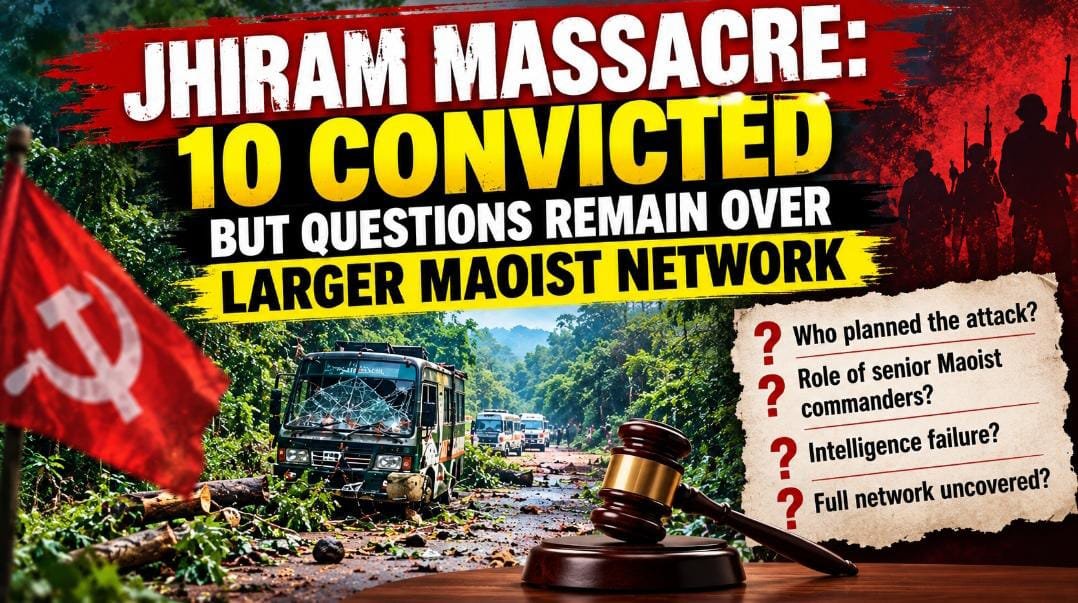
Thirteen years after the Jhiram Valley massacre wiped out a large part of Chhattisgarh Congress’s top leadership, an NIA court in Jagdalpur has sentenced 10 accused to death. But the verdict has also brought the spotlight back on several unanswered questions — including the alleged role of senior Maoist commanders, how the political convoy was targeted and whether the entire conspiracy has been uncovered.
The court convicted Pramila Modiyam, Chaitu Lekam alias Munna, Sumitra Punem, Modiyam Mukka, Mandvi Kosa Kawasi alias Kosaram, Ayata Markam, Madkami Deva, Joga Madkami, Banjami Sanna alias Chamru alias Denga and Mahadev Nag in the case.
The court observed that the death sentences would require confirmation by the High Court, while the accused have 30 days to appeal. The prosecution had sought the death penalty, while the defence argued for lesser punishment.
The trial, which continued for nearly 13 years, involved the examination of 101 witnesses and recording of documents, according to the material cited in the case.
The massacre took place on May 25, 2013, when the Congress’s Parivartan Yatra convoy was returning towards Sukma. As the convoy passed through the Jhiram Valley in the Darbha area, Maoists allegedly triggered an IED blast, blocked the road by felling trees and opened fire from the surrounding forest.
Among those killed were then state Congress president Nand Kumar Patel, former leader of opposition Mahendra Karma and former Union minister Vidya Charan Shukla. Patel’s son Dinesh Patel and several other Congress leaders and security personnel were also killed.
The attack effectively wiped out a significant part of the Congress’s top leadership in the state at the time.
From Minpa to Darbha
Investigative material cited in the case indicates that the Maoists had initially planned an attack on a security force camp in the Minpa area of Sukma. The plan was subsequently changed to target Darbha following a meeting at Pidiya village in Bijapur in February 2013, where senior Maoist commander Devji was allegedly present.
Following the change in plan, armed teams were moved towards Darbha. These included members of Military Company No. 2, Platoons 24 and 26, the Darbha Divisional Committee and CRC-2.
The preparations allegedly extended beyond mobilising armed cadres. According to the investigation, around 25 sacks of rice, each weighing about 50 kg, were collected from nearby villages and a temporary camp was established in the forest.
Different teams were allegedly assigned specific roles, including assault, stopping the convoy, signalling and triggering explosives.
The scale of these preparations has raised questions over how far up the Maoist command structure responsibility for planning the attack extended.
Who planned the attack and selected the target?
The key question emerging after the conviction of the 10 accused is whether they represented the entire operational chain behind an attack of such magnitude.
The material describes the convicted accused as lower-level cadres and raises questions about the possible involvement of a larger network in planning and executing the attack.
Questions also remain over how the Maoists obtained information about the movement of the Congress convoy and the presence of senior leaders, and at what level the target was finalised.
The investigation examined the role of different cadres and military units of the banned CPI (Maoist), but the present verdict is confined to the 10 accused tried in the case.
Questions over intelligence failure
Another issue that continues to surround the massacre is the security and intelligence system.
The convoy was travelling through a highly sensitive Maoist-affected area, yet a large armed group was able to mount an attack involving an IED, road blockade and sustained firing.
Questions have therefore been raised over whether intelligence inputs existed before the attack and, if so, why effective preventive action was not taken. If there was no prior input, questions arise over the functioning of the intelligence network.
The present verdict, according to the material, does not establish accountability for any alleged systemic or intelligence lapses.
Families question the scope of investigation
Questions have also been raised by the families of victims over the scope of the NIA investigation.
According to senior journalist Sudeep Thakur, the daughter of Mahendra Karma had raised questions about the investigation, including the fact that she was among the first to reach the spot after the incident but was allegedly not questioned by the NIA. Questions have also been raised over other potential witnesses who were allegedly not examined during the investigation.
Former chief minister Bhupesh Baghel has also alleged that the victims’ families have not received justice, claiming that the NIA did not properly investigate the case and that key accused were not arrested. He has further alleged that eyewitnesses present at the time of the attack were not questioned and that names of some alleged main accused were removed from the FIR.
These are allegations made by Baghel and have not been established as findings of the court.
4,184-page commission report remains another unresolved chapter
Another contentious aspect of the Jhiram case is the report of the judicial inquiry commission.
The commission, headed by Justice Prashant Kumar Mishra, was constituted by the then BJP government in 2013. After several years of proceedings, a report running into around 4,184 pages was submitted to the Governor in 2021.
The report subsequently became the subject of a political dispute. The then chief minister Bhupesh Baghel said it was incomplete and therefore should not be made public.
The government later decided to continue the commission with a new chairman and member and added fresh points to its terms of reference. Justice Satish K Agnihotri was appointed chairman and Justice G. Minhajuddin a member. The move was challenged in the High Court, which stayed the functioning of the reconstituted commission in 2022 until further orders.
Thus, two parallel strands of investigation — the NIA probe and the judicial commission inquiry — have remained part of the long-running Jhiram controversy.
33 accused still out of court’s reach
The conviction of 10 accused does not bring the entire case to a close. Around 33 other accused are stated to be absconding, according to the material.
Investigative records cited in the report identify Thippiri Tirupati alias Devji as a senior commander of the Maoist organisation’s regional command at the time of the attack. Barse Sukka alias Deva was allegedly secretary of the Darbha Divisional Committee and later became commander of Battalion-1. Their alleged roles in the Jhiram attack were part of the investigation.
The NIA had issued a wanted notice on December 23, 2023, carrying details of 19 Maoists, including Devji and Deva.
Both subsequently surrendered in Telangana in 2026 — Devji on February 24 and Deva on January 2.
The material further states that Devji appeared for his Intermediate second-year Telugu examination in May 2026 after his surrender, while questions have been raised over whether he has been interrogated in connection with the Jhiram case.
Another accused, Katkam Sudarshan, died in 2023. The biggest wanted accused identified in the material is Muppala Lakshmana Rao alias Ganapathi, who was CPI (Maoist) general secretary at the time of the attack and remains at large, according to the report.
The death sentences against the 10 convicted accused therefore mark a significant judicial development in the 2013 massacre, but the larger questions surrounding the planning, command structure, intelligence failures and the full network behind the attack remain central to the Jhiram case.