75.08% voter turnout reported in 70 seats that went to polls in the second phase in Chhattisgarh, Overall 75.73% polling recorded

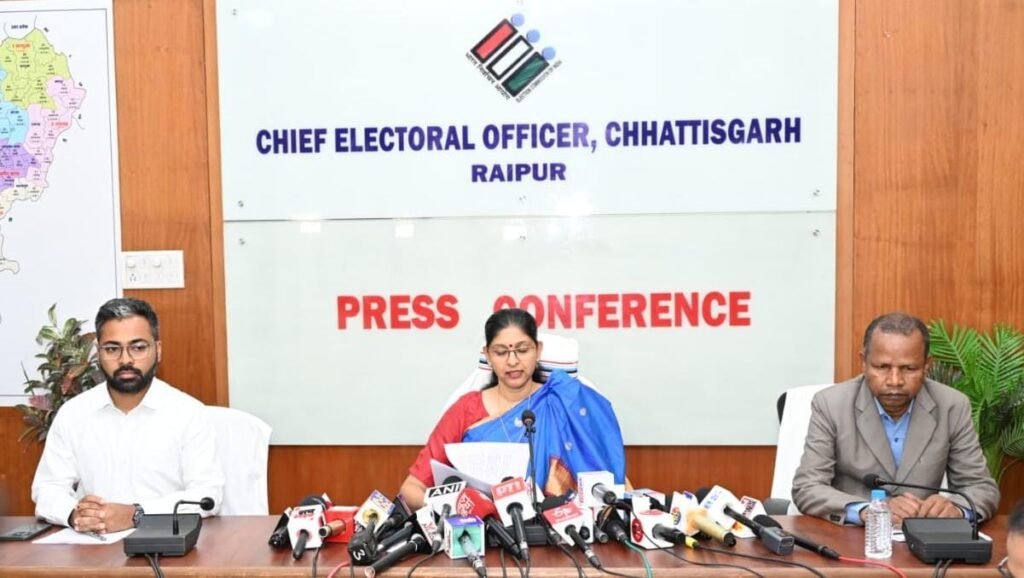
Raipur Chhattisgarh recorded overall 75.73% voter turnout in the 90 assembly constituencies went to the polls in two phases – November 7 and 17, respectively. Overall 75.08% voting was recorded in the second phase of the state assembly elections. Compared to 2018, this year witnessed a 0.09% decrease in voting across the 70 seats that went to the polls in the second phase. In the last elections, overall 75.17% voting was recorded in these 70 constituencies. The lowest turnout was 65.45% in Raipur, while the highest was 84.23% in Dhamtari in this elections. Notably, in the Naxal-affected Bindranawagarh, voting reached 91% across 9 booths. The election results will be out on December 3rd. Out of the 70 seats where voting occurred, the Congress holds sway over 51 seats. During the previous elections in 2018, the Marwahi constituency was with the JCCJ party. However, post the former CM Ajit Jogi’s demise, this seat also shifted to Congress in the by-polls. Elections to 20 seats were held in the first phase on November 7. The results will be out on December 3. This election was significantly different in many ways. No uproar, no banners, no posters, clear roads and walls… this was unprecedented. Despite that, people sacrificed their votes at the altar of democracy, according to the election commission. Last time, 76.45% of people of the state across 90 assembly constituencies had decided the new government, and this time, 75.08% have cast their votes. The first phase witnessed 78% voting on 20 seats. The rise or fall in voting percentage doesn’t necessarily affect the government formation. Usually, increased voting implies voting against the ruling party. However, the figures from Chhattisgarh’s previous elections tell a different story. In 2003, BJP won on 50 seats while Congress got 37 seats, with a total voter turnout of 71.30%. When the government was formed in 2008, the voting decreased. It was at 70.51%. This was almost 1% less than in 2003. BJP got 50 seats, and Congress got 38 seats. BJP received 40.33% and Congress 38.63% of votes in this election. In 2013, the voter turnout increased significantly, but BJP still formed the government. The voter turnout was at 77.12%, and BJP got 49 seats. Congress had to settle for 38 seats once again. Conversely, in 2018, with a voting percentage of 76.35%, Congress defeated BJP badly. Thus, the fluctuation in voting percentage doesn’t necessarily affect the government’s formation. However, the last time, the margin of victory was significantly higher in terms of voting share. There was less than a 1% difference in the first voting share, while in 2018, it was 10%. \The voting percentages in different districts stood as follows: Raipur: 65.45% Durg: 71.59% Bilaspur: 67.35% Raigarh: 83.92% Surguja: 80.18%