Dispatch News.
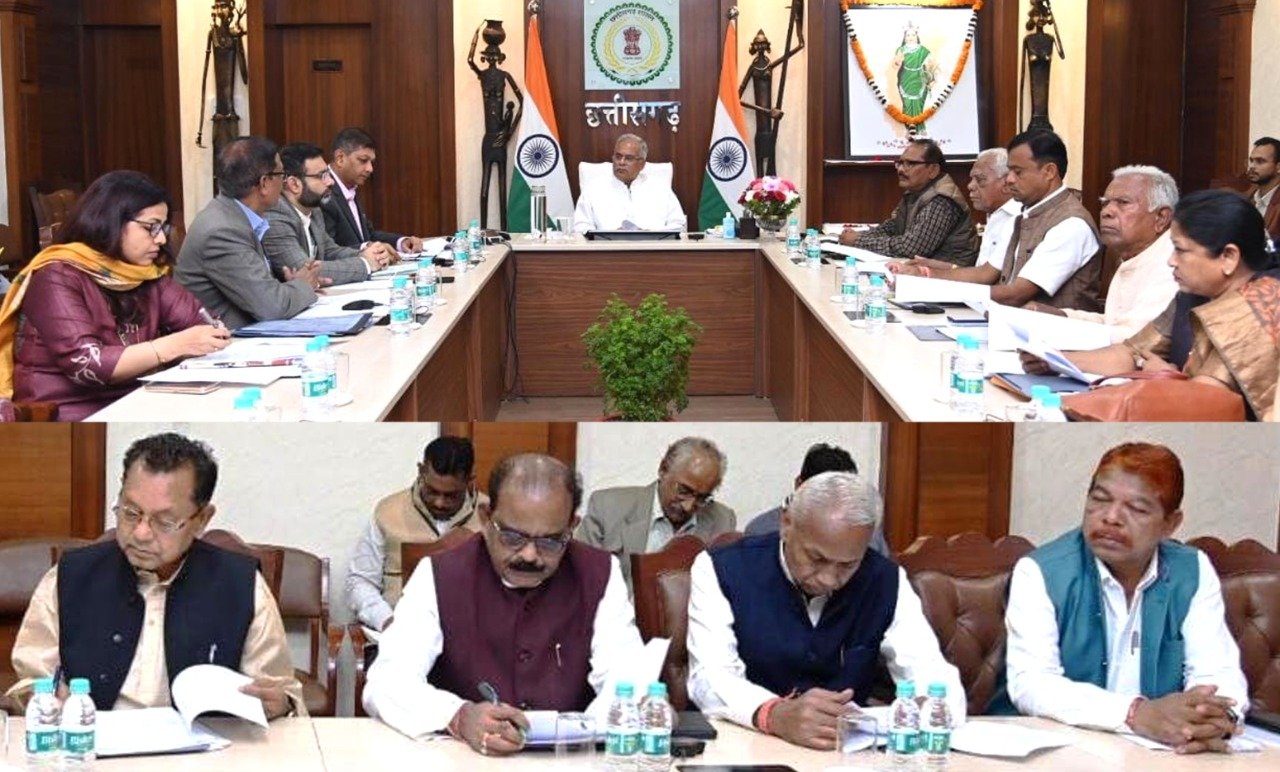
Raipur. On Monday evening, Chief Minister Bhupesh Baghel presided over an important meeting of the Chhattisgarh Tribal Advisory Council at his official residence in Raipur. The discussion concerned the situation caused by the stalling of the Reservation Amendment Bill for Scheduled Castes, Scheduled Tribes, and Other Backward Classes and the Chhattisgarh Educational Institutions (Reservation in Admission) Amendment Bill. The Chhattisgarh Legislative Assembly passed both bills during the special session on December 2, 2022.
These bills include a 32% reservation provision for scheduled tribes. Due to Raj Bhawan’s failure to approve this bill, the Scheduled Tribes, along with other classes, are facing difficulties in obtaining jobs and admission to educational institutions.
They decided that tribal legislators would return to meet with Governor AnusuiyaUikey and present the advisory committee’s recommendation. Dr Premsai Singh Tekam, Vice President of the Chhattisgarh Tribal Advisory Council, and MLA Rampukar Singh were among those in attendance.
At the council meeting, the attendees also discussed the proposition to not privatise the Nagarnar Steel Plant. They decided to send a proposal to the central government. The central government has proposed privatising this steel plant.
During the meeting, the Chief Minister stated that those who disrupt community harmony in designated areas should face immediate consequences.
In the Reservation Amendment Bill, 13% of the reservation was provisioned for scheduled castes, 32% for scheduled tribes, 27% for other backward classes, and 4% for the poor general category, raising the total reservation to 76%. When the bill reached the Governor’s House, she stopped it for legal examination, as the Chhattisgarh High Court has capped the reservation at 50%.
The High Court issued its decision in the Guru Ghasidas Literature and Culture Academy case on September 19, resulting in the current situation.
The General Administration Department sought opinions from the Law Department and the Advocate General’s Office. But both office did not clarify the position.
The General Administration Department informed under the Right to Information Act that, after the decision of the High Court, no reservation roster is functional in the state as of September 29.
Tribal societies began protests across the state. The Governor and the Chief Minister received the demand letter. Four ministers and tribal MLAs from the government attended the Sarv Adivasi Samaj meetings.
The Public Service Commission and Vyapam postponed recruitment tests due to the non-availability of reservations. The government withheld the results of the positions for the conducted examinations. Later, new advertisements did not include the reservation roster.
On October 21, the government filed a writ petition in the Supreme Court seeking to stop the implementation of the High Court’s decision. According to the affidavit, recruitment in the state has ceased following the High Court’s decision.
Governor Anusuiya Uikey wrote a letter to the Chief Minister expressing concern over the situation. It was suggested that the government introduce legislation or call a special session of the legislature to increase the reservation.
The government decided to pass the bill. The Raj Bhavan received the request to hold the Vidhansabha session on December 1-2; that same day, the Governor approved it, and the notification was published the following day.
On November 24, a cabinet meeting presided over by Chief Minister Bhupesh Baghel approved the proposal for reservation amendment bills.
On December 2, after a heated debate, the Assembly unanimously passed the Reservation Amendment Bill. In the bill, SC received 13% reservations, 32% to ST, 27% to OBC, and 4% to the poor general category. Reservations were fixed in proportion to the population in district cadre recruitments. The maximum limit is 27% for OBCs and 4% for the general poor.
On the night of December 2 itself, five ministers came to meet the Governor regarding the bills. Here, the Governor assured us that she would sign the bills soon. The next day, the Governor said to sign by Monday, but it did not happen.
On December 14, the Governor asked the government ten questions. As she said, it is impossible to decide on the bills without getting an answer. After ten days, the government sent the reply to the Raj Bhavan. The Raj Bhavan deemed that response insufficient and stated that the government did not answer her questions. The Quantifiable Data Commission’s report was not included.
On January 3, Congress held a large rally in Raipur to challenge the Governor’s inflexibility. The reservation case has shocked tribal society: the Supreme Court has refused to grant interim relief to continue the 58% reservation, with a hearing scheduled for March 22-23.