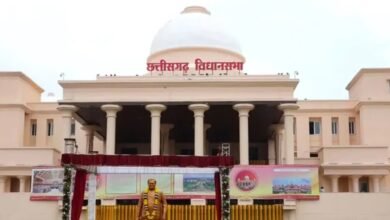
Raipur – The Chhattisgarh Legislative Assembly on Thursday passed the Chhattisgarh Dharm Swatantra Vidheyak (Freedom of Religion Bill), 2026, by voice vote following a five-hour discussion. The proceedings saw significant disruption as the Opposition Congress staged a walkout and boycotted the session for the remainder of the day.
The legislation aims to prevent religious conversions carried out through misrepresentation, force, undue influence, coercion, allurement, or fraudulent means, including those conducted via digital platforms.
Under the provisions of the bill, any individual intending to convert to another religion must submit a declaration to the ‘competent authority’—a district magistrate or an authorised officer not below the rank of additional district magistrate. This declaration must be filed in a prescribed format within the local jurisdiction of the intended conversion. These requirements also apply to members of Scheduled Tribes.
The bill mandates that the religious convertor, such as a priest or maulvi performing the ceremony, must also submit a declaration of the intended conversion to the competent authority. Upon receiving these notices, the authority will publish the details on its official website and display them at the offices of the Tehsildar, Gram Panchayat, and the local police station.
Any person may file a written objection to the proposed conversion within 30 days of the notice. The competent authority must then conduct an inquiry and pass a final order within 30 days. If the authority finds that an offence has been committed under the Act, the declaration will be cancelled, and a report will be sent to the police.
For marriages where religious conversion is the sole purpose, the bill requires the parties and the person performing the marriage to submit a declaration at least 60 days before the wedding date. The competent authority will then investigate whether the marriage is intended for illegal conversion.
The legislation prescribes heavy penalties for violations. General illegal conversions can lead to imprisonment ranging from seven to ten years and a fine of up to ₹5 lakh. If the conversion involves a minor, a woman, or a person from a Scheduled Caste or Scheduled Tribe, the punishment increases to a minimum of ten years in prison, extendable to life imprisonment, along with a fine of at least ₹25 lakh.
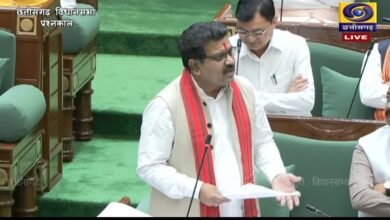
Earlier, as Home Minister Vijay Sharma rose to table the bill, Leader of Opposition (LoP) Charan Das Mahant requested the Chair to disallow the proceedings. The Chair ruled that the Home Minister be permitted to present the bill, after which the Opposition would be granted time to speak.
The LoP questioned the state government’s haste and suggested the bill be referred to a Select Committee involving Supreme Court or High Court judges. “The soul of India is diversity and tolerance. We should not take any step in a hurry that may divide society,” the LoP said, noting that similar laws from 11 states are currently under Supreme Court consideration.
BJP MLA Ajay Chandrakar countered the LoP, stating that the Supreme Court has not barred the formation of such laws. He referenced the Bhawanishankar Niogi Committee formed in 1954 regarding forced conversions.
Home Minister Vijay Sharma said Article 25 of the Constitution empowers the state to form laws regarding public order. He described the Opposition walkout as ‘palayan’ (absconding) from a discussion on a significant issue.
The Chhattisgarh cabinet, chaired by Chief Minister Vishnu Deo Sai, had earlier approved the draft. Officials said a conversion would be valid only after complying with the process of intimation, approval, and publication in a local newspaper. The legislation aims to prevent disturbances in sensitive tribal regions like Bastar, Raigarh, Jashpur, and Surguja.
The Act will extend to the entire state of Chhattisgarh and will come into force on a date notified by the state government in the official gazette.
The legislation, comprising six chapters and 31 points, introduces some of the toughest penalties:
- General illegal conversion: Prison terms ranging from seven to 10 years and a minimum fine of Rs 5 lakh.
- Special categories: Cases involving women, minors, or persons belonging to Scheduled Castes and Scheduled Tribes carry a sentence of 10 to 20 years.
- Mass Conversion: Provision for life imprisonment.
- All offences under this Act will be cognizable and non-bailable.