Over three evenings at the 2026 Jaipur Litfest, literature became a meeting ground where borders softened, languages leaned into each other, and poetry spoke in the quiet registers of belonging, loss, and resilience. Presented by the Austrian Cultural Forum, Austrian Embassy New Delhi and the Ukrainian Embassy New Delhi under the framework of Austrian–Ukrainian Cultural Cooperation, the literary programme unfolded as a deeply thoughtful exploration of how writers respond to fractured geographies and unsettled times.
Rather than positioning literature as ornament or escape, the sessions asserted it as a living, breathing practice—one that records history, resists erasure, and imagines futures beyond the immediate violence of the present.
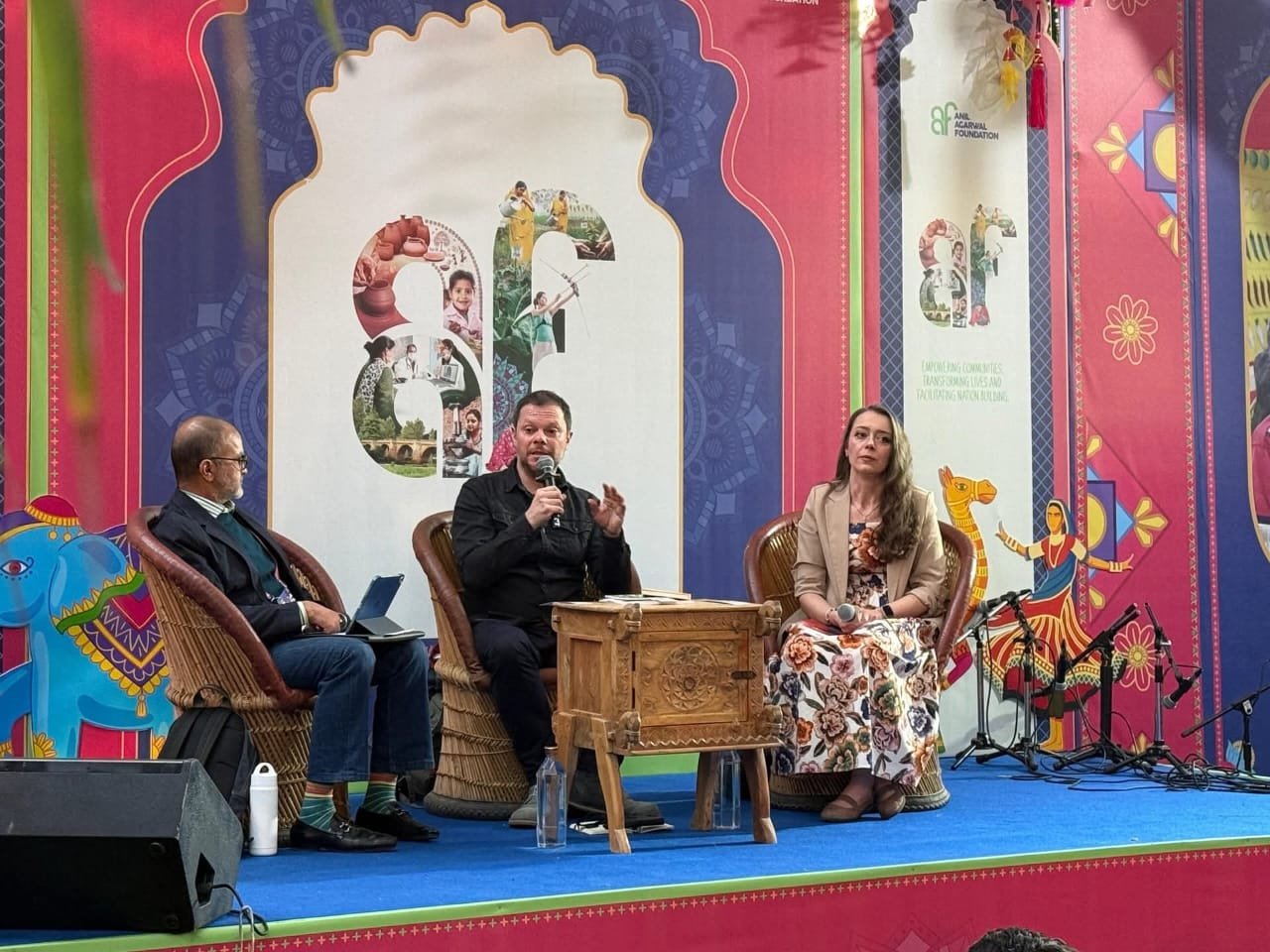
The programme opened with The Geography of Belonging, a conversation between Austrian writer Andreas Unterweger and Indian graphic novelist and cultural commentator Sarnath Banerjee, moderated by Swati Chopra. What began as a discussion on place soon widened into a meditation on displacement, memory, and the invisible cartographies that writers carry within them.
Unterweger reflected on how European landscapes—layered with history, war, and silence—continue to shape contemporary writing, even when they are no longer explicitly named. Banerjee, drawing from his own work and India’s postcolonial experience, spoke of belonging as something constantly negotiated rather than inherited. The exchange resisted easy binaries of home and exile, suggesting instead that modern literature often exists in a state of productive dislocation.
If the opening session was cerebral and discursive, the second evening—Poetry Hour: Unquiet Words—brought emotion to the fore. Featuring poets Badri Narayan, Parwati Tirkey, Charmi Chheda, Yulia Musakovska, and Radha Chakravarty, the reading assembled voices working across languages, regions, and lived realities. Introduced by Anisha Lalvani, the session framed poetry as a form that does not merely describe unrest but absorbs and transforms it.
From reflections on marginalised histories and ecological grief to poems shaped by war and intimate loss, the readings revealed poetry’s ability to hold contradictions—anger and tenderness, despair and defiance—within the same breath. Ukrainian poet Yulia Musakovska’s work, marked by restraint rather than spectacle, resonated strongly, reminding listeners that in times of conflict, poetry often speaks most powerfully through understatement.
The programme concluded with Between Us: Poems Beyond Language, a conversation between Musakovska and Unterweger, moderated by Asad Lalljee. Michael Pal, Director, Austrian Cultural Forum, was also present on the occasion alongside Volodymyr Prytula, Second Secretary, Embassy of Ukraine.
This final session turned inward, focusing on translation—not merely as a technical act, but as an ethical and emotional one. What does it mean to carry a poem across languages when its original context is marked by violence? What survives translation, and what must be allowed to change?
Both writers spoke of poetry as an intimate act of listening—between writer and reader, between languages, and between histories that may never fully align. Translation, they suggested, is less about equivalence and more about trust: trusting another language to hold what was once private.
Taken together, the three sessions formed a coherent arc—moving from geography to voice, and finally to the fragile space between languages. The presence of Indian writers and moderators ensured that the conversations were not framed as distant European concerns but as part of a shared global condition, one where questions of belonging, memory, and rupture are increasingly universal.
In a cultural moment often dominated by speed and spectacle, the Austrian–Ukrainian literary programme stood out for its quiet seriousness. It reminded audiences that literature does not offer solutions in the policy sense, but it does something equally vital: it preserves complexity, refuses simplification, and keeps open the possibility of dialogue.
As the final evening drew to a close, what lingered was not a single argument or performance, but a shared recognition—that across borders and languages, words remain one of the most enduring ways we find each other.