Finance Minister unveils Yuva Shakti-driven Budget, targets high growth with fiscal prudence

Raipur
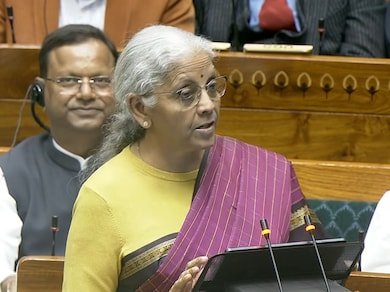
Finance Minister Nirmala Sitharaman today presented the Union Budget 2026-27, describing it as a “Yuva Shakti-driven” roadmap for Viksit Bharat that combines continued high growth, a sharper focus on services and youth employment, and gradual fiscal consolidation. She said the government, in power for 12 years, had delivered stability, fiscal discipline, sustained growth and moderate inflation, enabling about 25 crore people to move out of multidimensional poverty over the past decade.
Growth, capex and fiscal math
The Budget pegs the fiscal deficit for 2026-27 at 4.3% of GDP, marginally lower than the revised estimate of 4.4% for 2025-26, and reiterates the goal of bringing the Centre’s debt-to-GDP ratio to 50±1% by 2030-31. The debt ratio is projected to ease to 55.6% in 2026-27 from 56.1% in 2025-26, with the Minister stressing that lower debt will free more resources for priority spending.
Total expenditure in 2026-27 is estimated at ₹53.5 lakh crore, with non-debt receipts at ₹36.5 lakh crore and net tax revenue at ₹28.7 lakh crore. Public capital expenditure (capex) will rise further to ₹12.2 lakh crore, continuing the government’s infrastructure push. Net market borrowings are pegged at ₹11.7 lakh crore, with gross borrowings of ₹17.2 lakh crore.
Sitharaman framed the Budget around three “kartavya”:
accelerating growth, fulfilling aspirations and building capacity, and Sabka Sath, Sabka Vikas through inclusive development.
Big push to manufacturing, infra and cities
Key initiatives include scaling up manufacturing, strengthening MSMEs, boosting infrastructure, ensuring energy security, and building City Economic Regions (CERs).
Key measures:
- Biopharma SHAKTI – ₹10,000-crore, five-year plan to make India a global biopharma hub
- India Semiconductor Mission 2.0 – focus on equipment, materials, Indian IP and research & training
- Electronics Components Manufacturing Scheme outlay enhanced to ₹40,000 crore
- Rare Earth Corridors in Odisha, Kerala, Andhra Pradesh and Tamil Nadu
- Three new Chemical Parks under plug-and-play cluster model
For capital goods, the Budget announces hi-tech tool rooms, a construction equipment scheme, and a ₹10,000-crore container manufacturing scheme.
The textile sector gets an Integrated Programme, including National Fibre Scheme, cluster modernisation, Tex-Eco green initiative, Samarth 2.0, Mega Textile Parks, and Khadi & Village Industries push.
Infrastructure & connectivity
- Public capex jump from ₹2 lakh crore (2014-15) to ₹12.2 lakh crore (2026-27)
- Infrastructure Risk Guarantee Fund
- REIT-based monetisation of CPSE real estate
- Dedicated Freight Corridors – Dankuni–Surat
- 20 new National Waterways, starting with NW-5 (Odisha)
- Coastal Cargo Promotion Scheme to raise share to 12% by 2047
Seven proposed High-Speed Rail Corridors, including:
Mumbai–Pune, Hyderabad–Bengaluru, Delhi–Varanasi, Varanasi–Siliguri
Each City Economic Region to get up to ₹5,000 crore over five years.
Banking, markets and MSMEs
- High Level Committee on Banking for Viksit Bharat
- Restructuring of PFC and REC
- Review of FEMA (Non-Debt Instruments) rules
Financial markets:
- Corporate bond market deepening
- Municipal bond incentives up to ₹100 crore
- Higher FPI limits for NRIs
MSME support:
- ₹10,000-crore SME Growth Fund
- Self-Reliant India Fund – additional ₹2,000 crore
- TReDS-linked liquidity, Corporate Mitras for compliance
Services, youth and new-age skills
- Education to Employment and Enterprise Committee
- Target to raise India’s global services share to 10% by 2047
- AI-embedded curricula and future-ready skilling
Key sectors:
- Health & Allied Health Professionals
- Medical Value Tourism – 5 Regional Medical Hubs
- AYUSH expansion & WHO Global Traditional Medicine Centre
- AVGC / Orange Economy – Creative Tech Labs
- University Townships, Girls’ Hostels in STEM, Astrophysics facilities
Farmers, Divyangjan and regional focus
- 500 reservoirs & Amrit Sarovars for fisheries
- High-value crops – coconut, cashew, cocoa, sandalwood
- Bharat-VISTAAR AI tool for farmers
- SHE-Marts for women-led enterprises
Divyangjan schemes:
- Divyangjan Kaushal Yojana
- Divyang Sahara Yojana
- NIMHANS-2, mental health upgrades
- Purvodaya agenda & North-East Buddhist Circuit
Tax reforms: New IT Act & reliefs
- Income Tax Act, 2025 from April 1, 2026
- Relief on TDS, TCS, simplified ITRs
- FAST-DS for small taxpayers
- Decriminalisation of minor offences
- MAT revamped to 14% final tax
Customs, GST and exports
- Duty-free critical minerals, renewables, nuclear inputs
- 17 life-saving cancer drugs exempted
- Courier export cap removed
- AI-based customs scanning, trust-based clearances
- GST rationalisation and faster refunds
The Finance Minister concluded by reaffirming the government’s “Sankalp” towards the poor, underprivileged and disadvantaged, ending her speech with “Jai Hind” 🇮🇳