210 Maoists surrender in Bastar under Chhattisgarh’s ‘Puna Margem’ policy, marking historic step toward peace

Raipur
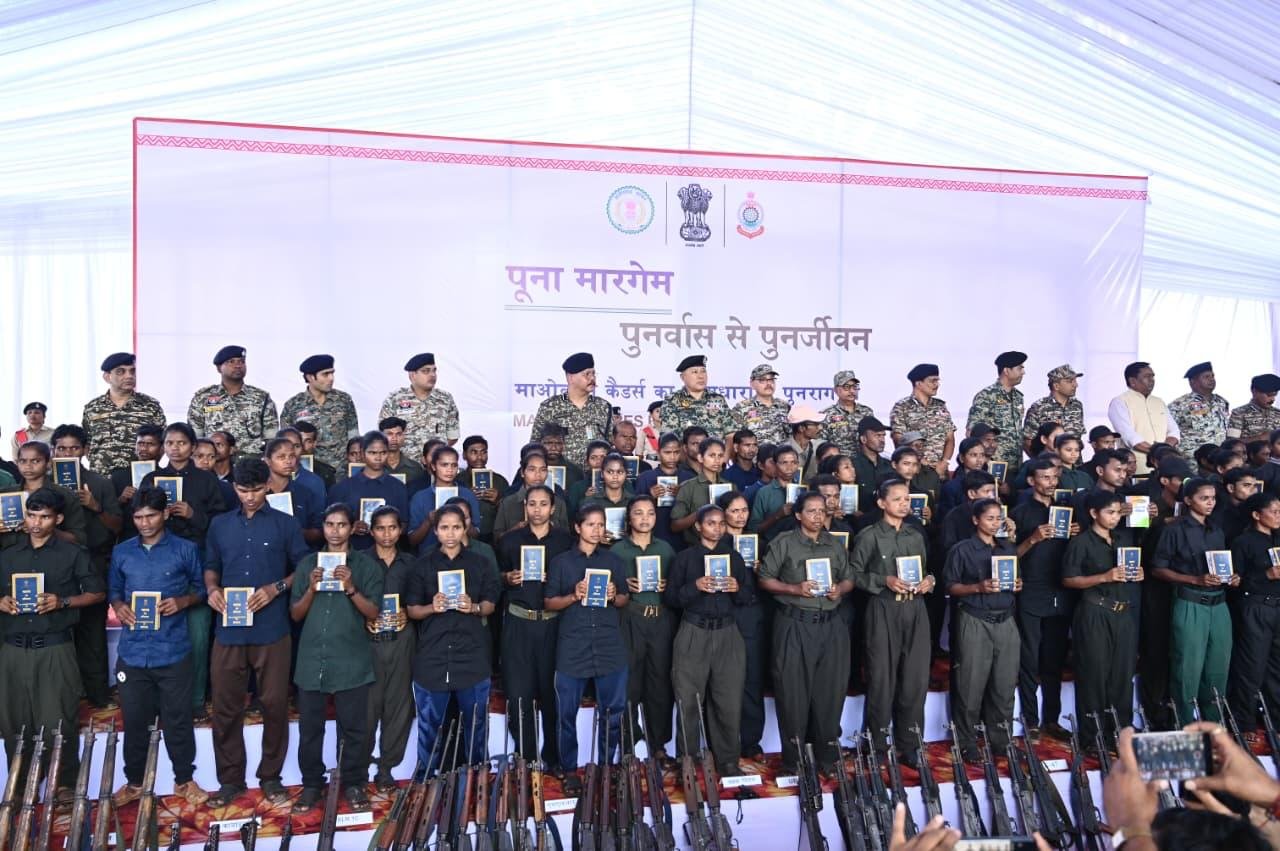
The state government’s extensive Naxal elimination policy, centred on peace, dialogue, and development, achieved a historic milestone in the Bastar division on Friday. A total of 210 Maoist cadres from the Dandakaranya region have shunned violence and returned to the social mainstream under the ‘Puna Margem, Punarvas Se Punarjeeevan’ (Rehabilitation to Rejuvenation) programme.
This mass surrender signals a new dawn for Bastar toward trust, security, and development. This historic event, impacting the long-affected Abujhmarh and North Bastar areas, will be recorded as a decisive turning point in the history of the anti-Naxal campaign.
The comprehensive Naxal elimination policy adopted by the state government, led by Chief Minister Vishnu Deo Sai, has laid a strong foundation for lasting peace in the region. Coordinated efforts by the police, security forces, local administration, social organisations, and vigilant citizens have successfully transformed the culture of violence into one of dialogue and development.
This is the first time in the history of the anti-Naxal operation that such a large number of senior Maoist cadres have surrendered simultaneously. Among those who have given up arms are one Central Committee Member (CCM), four DK-SZC members, and 21 Divisional Committee members, besides other senior leaders.
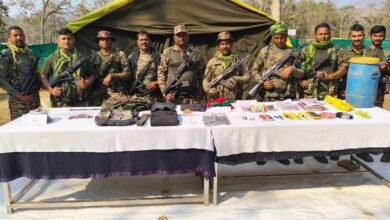
The cadres surrendered a total of 153 sophisticated weapons, including AK-47, SLR, INSAS rifles, and LMGs. This surrender is more than just a handing over of weapons; it is a symbolic end to an era of violence and fear, ushering in an age of peace and trust in Bastar.
Key Maoist leaders who returned to the mainstream include CCM Rupesh alias Satish, DK-SZC members Bhaskar alias Rajman Mandavi, Ranita, Raju Salam, Dhannu Vetti alias Santu, and RCM Ratan Elam, among several other wanted and high-reward cadres. All of them expressed faith in the Constitution and resolved to live a life of dignity within the democratic setup.
The historic event took place at the Jagdalpur Police Line complex, where the surrendered cadres were welcomed using the traditional Manjhi-Chalaki method. They were honoured with a copy of the Constitution and a red rose, symbolising peace, love, and a new life.
Director General of Police (DGP) Arun Dev Gautam, the chief guest at the function, stated, “‘Puna Nargem’ is not merely an effort to move away from Naxalism, but an opportunity to give life a new direction. Those who have returned today will become ambassadors of peace, development, and trust in Bastar.” He called upon the surrendered cadres to dedicate their energy to nation-building.
The event saw the presence of ADG (Naxal Operations) Vivekananda Sinha, CRPF Bastar Range In-charge, Commissioner Doman Singh, Bastar Range IG Sundarraj P., Collector Harish S., all Superintendents of Police in the Bastar division, senior officials, and representatives of social organisations.
During the programme, the Police Department provided the surrendered Maoists with information regarding rehabilitation assistance funds, housing, and livelihood schemes. The state government is committed to linking these individuals with self-employment, skill development, and education so they can lead a self-reliant and respectable life.
Manjhi-Chalaki representatives emphasised that the tradition of Bastar has always championed love, coexistence, and peace. They stated that the returnees would provide new strength to this tradition and solidify the foundation of trust in society.
The programme concluded with all the surrendered cadres taking an oath on the Constitution, expressing their allegiance to democratic values. They pledged to contribute to development and nation-building instead of violence.
The event, culminating in the resonance of ‘Vande Mataram’, became a symbol not just of the surrender of 210 Maoist cadres but of the beginning of a new era of trust, development, and peace in Bastar.
Sai hails Bastar surrender as ‘historic day’
Chief Minister Vishnu Deo Sai on Friday termed the surrender of 210 Maoist cadres in Bastar a historic moment not just for Chhattisgarh but for the entire nation.
He said the youths, who were previously trapped in the false ideology of Maoism, have resolved to join the mainstream of the Constitution, democracy, and development.
Change and Trust
Speaking on the occasion, Sai stated that the day marked a significant milestone for Bastar, Chhattisgarh, and the country. He noted that the youths, who had chosen the path of violence for years, have now shed their arms and embraced the Constitution. The Chief Minister emphasised that the event signified not just a surrender, but a new beginning of trust and transformation.
Rehabilitation Policy Impact
Chief Minister Sai described his meeting with the surrendered youths, who chose good governance over the gun, as one of the most emotional and satisfying moments of his life. He asserted that the scene proves change is brought about by policies and trust.
He cited the State Government’s Naxal Surrender and Rehabilitation Policy 2025, along with schemes like ‘Niyad Nella Naar Yojana’ and ‘Poona Margem – Punarvaas Se Punarjivan’ (Rehabilitation to Rebirth), as calls for belief and transformation. These policies have prompted people in Naxal-affected areas to abandon violence and accept the government’s pledge of trust and development.
Commitment to Peace
The Chief Minister instructed the authorities concerned to ensure the complete rehabilitation and a bright future for the surrendered individuals.
He reiterated the Double Engine Government’s commitment to making Chhattisgarh completely Naxalism-free. He added that this pledge is being fulfilled under the guidance of Prime Minister Narendra Modi and the leadership of Union Home Minister Amit Shah.
Chhattisgarh is now moving towards a new era of peace, trust, and progress.